GEOTECHNICALENGINEERING1
FORT LAUDERDALE
HomeGeophysicsElectrical resistivity / VES (Vertical Electrical Sounding)

Electrical Resistivity Testing in Fort Lauderdale | VES Surveys

Site investigations you can build on.

LEARN MORE

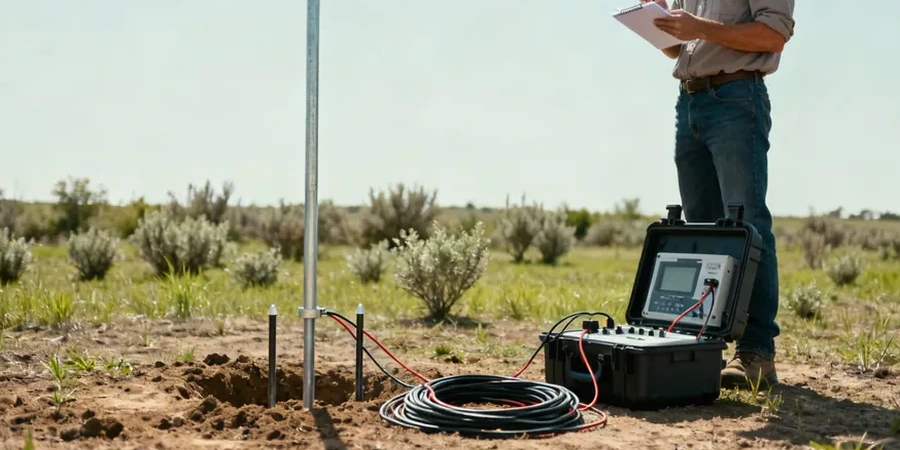
A common mistake in Fort Lauderdale is treating every site like it sits on uniform sand. The reality is more complicated. Much of the city lies over the Biscayne Aquifer, where freshwater lenses float atop denser saltwater, and solution cavities riddle the limestone at unpredictable depths. Standard borings give you data at a point, but they miss the lateral transitions between clean sand, organics, and weathered rock. That is where electrical resistivity testing becomes essential. By measuring how the subsurface resists current flow, we map these transitions continuously. The MASW survey often pairs well with resistivity here, because shear-wave velocity helps distinguish loose infill from competent limestone when the resistivity contrast is subtle. Our team runs vertical electrical soundings with 4-pin Wenner and Schlumberger arrays, calibrated against local USGS hydrogeologic profiles, so you know exactly what lies beneath the slab before excavation starts.

A resistivity line across a Fort Lauderdale site can reveal the saltwater wedge, a buried paleochannel, and a solution pipe in the same 400-foot profile.
Our service areas

Process and scope

Fort Lauderdale grew up on a coastal ridge barely three miles wide, squeezed between the Atlantic and the Everglades. Early developers in the 1920s filled mangrove swamps with dredge spoil, creating artificial ground that still confounds geotechnical investigation today. Electrical resistivity cuts through that noise. A Schlumberger array with AB/2 expanding to 300 feet will see through the fill, identify the freshwater-saltwater interface, and flag low-resistivity zones indicative of clay lenses or organic silts. The data is inverted with RES2DINV software using solid L1-norm optimization, producing 2D pseudo-sections that highlight anomalies as subtle as 10 ohm-m in a background of 200 ohm-m sand. Unlike mechanical probing, the method is non-invasive, so it works on congested urban lots where a drill rig cannot maneuver. The output integrates directly into geotechnical cross-sections for foundation design, dewatering plans, and excavation support.
Electrical Resistivity Testing in Fort Lauderdale | VES Surveys
Technical reference — Fort Lauderdale

Local considerations

Broward County sits at an average elevation of just 6 feet above sea level, and the USGS has documented saltwater intrusion moving inland at rates exceeding 300 feet per year in parts of the Biscayne Aquifer. For a contractor driving sheet piles near the New River, hitting an unmapped zone of hypersaline groundwater can collapse an excavation in minutes. The resistivity is so low in those zones that it effectively shorts the electrical field, but that very signature is what allows us to map the wedge precisely. On one Fort Lauderdale site, a VES survey flagged a 15-foot-thick lens of organic peat at 25 feet depth that three SPT borings had missed entirely because it pinched out between them. The geotechnical engineer redesigned the mat foundation with a rigid inclusion grid, saving the owner a six-figure change order. When you are building on a barrier island or within a mile of the Intracoastal, skipping resistivity is not a cost-saving decision; it is a risk you carry into the excavation blind.

Need a geotechnical assessment?

Reply within 24h.

Email: contact@geotechnicalengineering1.sbs

Applicable standards

ASTM D6431-18 (DC Resistivity), ASCE 7-22 (Seismic Site Class via Vs30 correlation), IBC 2021 Chapter 18 (Soils and Foundations), FHWA-NHI-05-037 (GEC No.5 - Subsurface Exploration)

Typical values

ParameterTypical value
Array configurationsWenner, Schlumberger, dipole-dipole
Maximum investigation depth (Schlumberger, AB/2 = 300 ft)~100 ft below grade
Typical resistivity range in Miami Limestone80 - 500 ohm-m (freshwater saturated)
Saltwater signature< 5 ohm-m
Data inversion softwareRES2DINV / EarthImager 2D
Applicable ASTM standardASTM D6431-18
Electrode material (saltwater environment)Stainless steel 316

Common questions

How deep can electrical resistivity testing see in Fort Lauderdale's coastal geology?

With a Schlumberger array and AB/2 extending to 300 feet, we typically resolve features down to about 100 feet below grade in the sandy and limestone formations common to Broward County. The depth of investigation is limited by the array geometry and the background resistivity, which in Fort Lauderdale generally ranges from 80 to 500 ohm-m for freshwater-saturated limestone. For deeper targets, we can run multiple soundings with larger spreads or combine resistivity with seismic methods.

What does electrical resistivity testing cost for a typical Fort Lauderdale site?
Can resistivity distinguish between freshwater and saltwater in the Biscayne Aquifer?

Yes, and it is one of the primary applications of the method in coastal South Florida. Freshwater-saturated limestone typically measures above 80 ohm-m, while saltwater intrusion drops resistivity below 5 ohm-m. The transition zone is usually sharp and mappable to within a few feet vertically, which makes VES an effective tool for setting dewatering well screens and cutoff wall depths.

Does a resistivity survey replace standard soil borings?

No, it complements them. Resistivity provides continuous subsurface coverage between discrete boring locations, revealing lateral changes that point data miss. The combination of resistivity profiles with SPT or CPT logs gives the most complete stratigraphic picture. We always recommend at least one calibration boring to tie resistivity boundaries to actual soil types and N-values before finalizing the geotechnical model.

Location and service area

We serve projects across Fort Lauderdale and surrounding areas.

View larger map