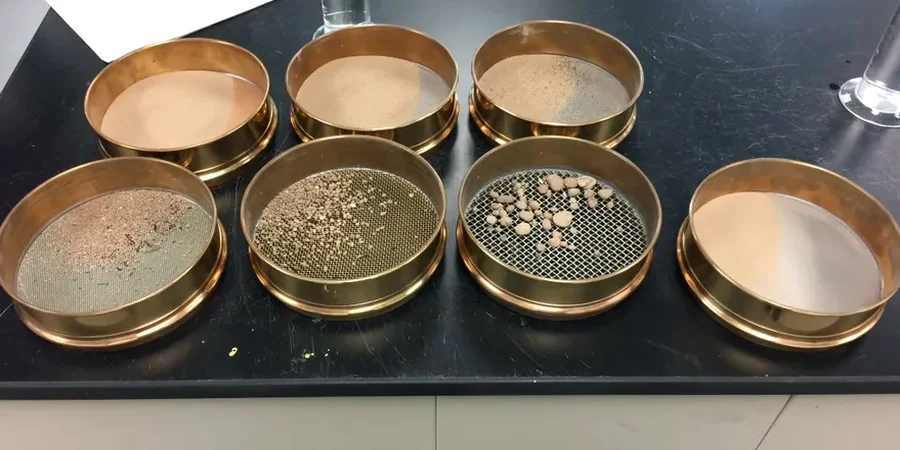
Along the barrier island and canal frontages of Fort Lauderdale, near-surface soils often carry a fine carbonate sand fraction that doesn't show up clearly in a standard sieve stack. We have seen this repeatedly in the Las Olas Isles and Rio Vista neighborhoods, where a hydrometer extension becomes essential for accurate classification. A grain size analysis performed only to the No. 200 sieve misses the silt and clay curve that controls drainage behavior in flat, high-water-table sites. Our lab runs the full ASTM D422/D6913 combined method, giving Fort Lauderdale engineers a single particle-size distribution from coarse sand down to the clay fraction. This data feeds directly into USCS classification per ASTM D2487, compaction specification checks, and seepage assessments. For deep foundation projects near the Intracoastal, where SPT drilling samples encounter interbedded silty layers, the hydrometer tail often reveals a gap-graded fabric that influences pile skin friction assumptions. The combined sieve-plus-hydrometer report typically ships in three to four business days.
A complete grain size curve down to the clay fraction is the difference between a borderline SW-SM classification and a properly identified SC material that will behave very differently under Fort Lauderdale's high water table.