GEOTECHNICALENGINEERING1
FORT LAUDERDALE
HomeFoundationsPile foundation design

Pile Foundation Design in Fort Lauderdale — Deep Foundations for Coastal Florida Soils

Site investigations you can build on.

LEARN MORE

A common mistake in Fort Lauderdale is treating the entire site like it sits on competent limestone when, in reality, the upper 10 to 30 feet often consist of loose sands, organic silts, or urban fill with erratic density. A project in the Las Olas Isles area that proceeds with shallow footings without verifying deep stratigraphy risks differential settlement that cracks the superstructure within the first two wet seasons. Our pile foundation design process begins by mapping the depth to the Fort Thompson Formation or the Miami Oolite, because the capacity of any driven or augered element depends entirely on whether the tip bears on calcarenite, dense sand, or softer interbedded marl. At sites near the New River, where the water table sits barely three feet below grade, we combine SPT data from a CPT test campaign with laboratory triaxial results to define side friction in saturated sands and to confirm that the proposed pile length bypasses the scourable zone identified in the hydraulic report.

In Fort Lauderdale, pile capacity is governed less by the pile section and more by the quality of the side-friction bond through the fluctuating freshwater-saltwater interface zone.
Our service areas

Process and scope

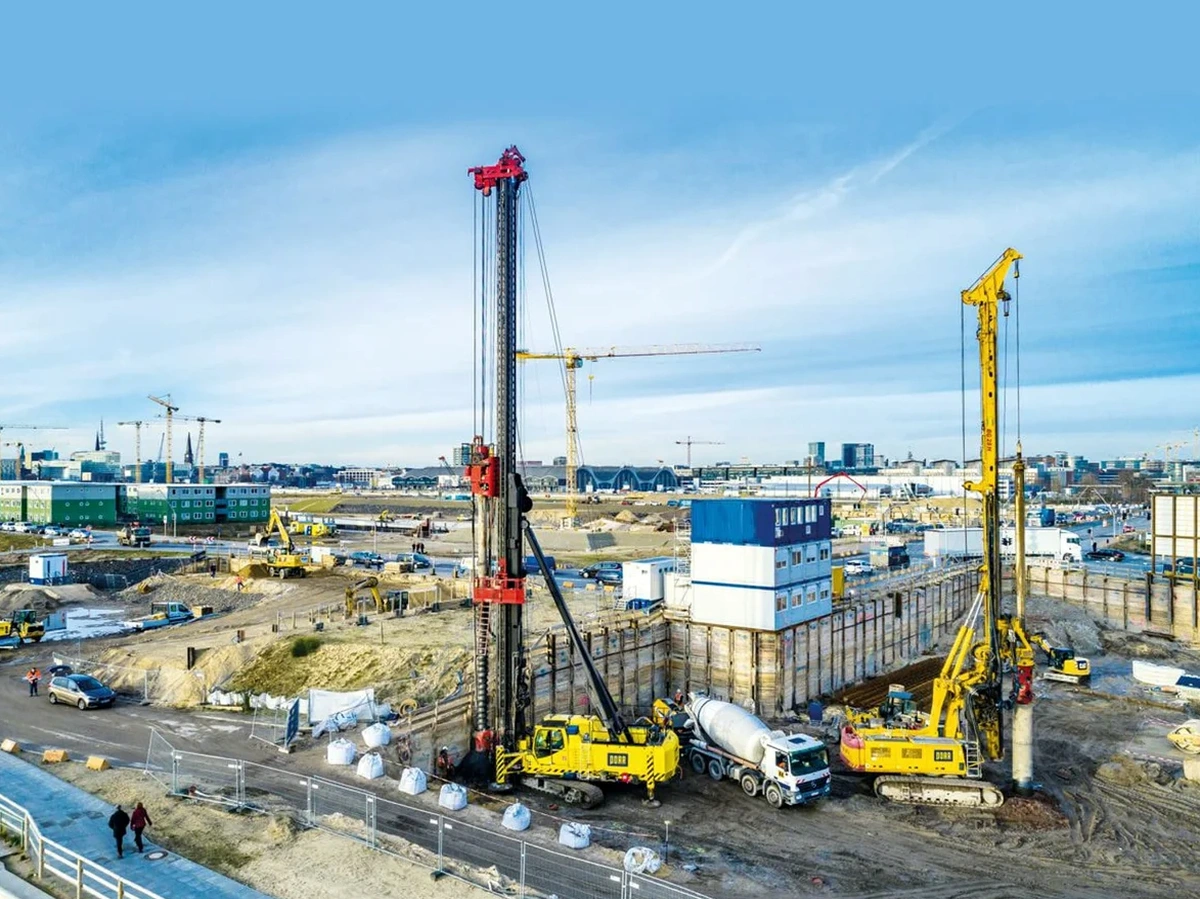
The equipment mobilized to a Fort Lauderdale site must handle saturated, low-bearing-capacity surface soils without excessive vibration near existing structures. For augered cast-in-place piles, we typically specify rigs with a torque head capable of 250 kN-m or more, because the coralline limestone layers encountered between 20 and 45 feet can stall smaller units and lead to necking if the concrete head is not maintained during extraction. Hollow-stem augers with automatic SPT hammers collect split-spoon samples at five-foot intervals, and the recovered material is logged under ASTM D2488 by a geologist who distinguishes between the Biscayne aquifer facies and the more competent Key Largo Limestone. For driven precast or H-pile alternatives, hydraulic hammers rated for 80 to 120 kip-ft energy are paired with pile driving analyzer (PDA) sensors to capture dynamic capacity in real time, allowing the engineer to adjust the final set criteria before cutoff elevation without waiting for static load test results. This equipment configuration permits installation through the thin sand lenses and solution-riddled rock that characterize the Floridan aquifer system, reducing the risk that a pile hangs up on a hardpan layer while the adjacent pile advances to the design tip elevation.
Pile Foundation Design in Fort Lauderdale — Deep Foundations for Coastal Florida Soils
Technical reference — Fort Lauderdale

Local considerations

The contrast between Fort Lauderdale's dry-winter construction season and the June-through-November tropical-storm cycle dictates the pile design sequence and the required redundancy in the foundation system. When a hurricane surge raises the water table by several feet in a matter of hours, poorly socketed piles can experience a sudden loss of skin friction in the softened upper zone, while the increased pore pressure reduces effective stress at the tip. Our designs incorporate a minimum socket of 1.5 pile diameters into competent rock below the lowest anticipated scour elevation, and we specify a sacrificial steel thickness for driven piles in the splash zone, calculated from the FDOT corrosion rate maps for Broward County. Foundation elements located within 500 feet of a seawall or bulkhead receive an additional lateral load case equal to the wave-induced pressure estimated from the FEMA Coastal Construction Manual, because the hydraulic connectivity between the Intracoastal Waterway and the underlying Biscayne aquifer transmits surge energy directly to the pile shaft.

Need a geotechnical assessment?

Reply within 24h.

Email: contact@geotechnicalengineering1.sbs

Applicable standards

IBC 2021 Section 1810 — Deep Foundations, ASCE 7-22 Chapter 12 — Seismic Design Requirements for Site Class D/E, ASTM D1143-20 — Standard Test Methods for Deep Foundation Elements Under Static Axial Compressive Load, ASTM D4945-17 — Standard Test Method for High-Strain Dynamic Testing of Deep Foundations, FDOT Soils and Foundations Handbook (current edition) — Driven Pile and Drilled Shaft Provisions for Florida Carbonate Formations

Typical values

ParameterTypical value
Design methodLRFD per AASHTO / IBC Section 1810; service-level verification for scour
Minimum pile embedment10 ft into competent limestone or 20 ft below design scour depth, whichever is deeper
Lateral load analysisLPILE or COM624P using p-y curves for submerged carbonate sands
Shaft resistance in coral rock20–50 ksf (unit side friction, verified by full-scale load test)
Base resistance (augered pile)40–100 ksf on Fort Thompson calcarenite, subject to socket roughness factor
Settlement threshold0.5 inches total, 0.3 inches differential for pile groups under sustained dead load
Corrosion protectionMinimum 2.5 in cover for CIP piles in chloride-exposed environment; epoxy coating for steel H-piles
Load test requirementASTM D1143 (static) or ASTM D4945 (high-strain dynamic) on minimum 2% of production piles

Common questions

What is the typical cost range for pile foundation design on a single-family residential lot in Fort Lauderdale?
How do you determine whether augered cast-in-place piles are feasible versus driven piles in Fort Lauderdale?

The decision turns on the depth and thickness of the limestone layers, the proximity of adjacent structures, and the allowable vibration limits set by the city. We log the SPT refusal depth from preliminary borings: if the Miami Oolite or Fort Thompson Formation appears as a continuous layer above 40 feet and the site has no vibration-sensitive neighbors, driven precast piles become economical. When the rock surface is highly irregular or the site is within 50 feet of an occupied building, augered piles installed with temporary casing through the sand zone minimize the risk of ground loss and vibration-induced settlement.

What additional design considerations apply to pile foundations near the Intracoastal Waterway?

Three factors dominate: scour, lateral surge loads, and chloride-induced corrosion. We apply the HEC-18 scour equations using the 100-year storm velocity for the reach of the Intracoastal near the project, and we extend the pile socket at least 1.5 diameters below the calculated scour depth. Lateral analysis includes a wave force case from ASCE 7 Chapter 5, and we specify a minimum 3-inch concrete cover for cast-in-place piles or a fusion-bonded epoxy coating for steel H-piles to address the salt-spray exposure zone.

What quality-control documentation do you provide for pile installation in Fort Lauderdale?

Each project receives a pile installation record log that includes the date, pile number, as-built cutoff elevation, total driven or drilled depth, hammer energy or torque readings, concrete volume versus theoretical volume, and any observations of groundwater inflow or drilling fluid loss. For test piles, we add the calibrated strain-gage and telltale data with the interpreted load-transfer curves. The final report references the specific ASTM test methods used and is signed and sealed for submission to the Fort Lauderdale Building Services Division.

How do the interbedded sand and limestone layers in Fort Lauderdale affect pile group efficiency?

The alternating hard and soft layers can create a punching scenario where the pile group settlement is controlled by the compression of the softer sand seams below the pile tips, not by the rock socket capacity. We model the group using an equivalent raft approach in the finite element program, assigning a modulus reduction factor to the sand layers based on the SPT N-value. The group efficiency factor is then back-calculated for the design load combination, and we adjust the pile spacing or the socket length until the total and differential settlement stay within the 0.5-inch and 0.3-inch limits.

Location and service area

We serve projects across Fort Lauderdale and surrounding areas.

View larger map